


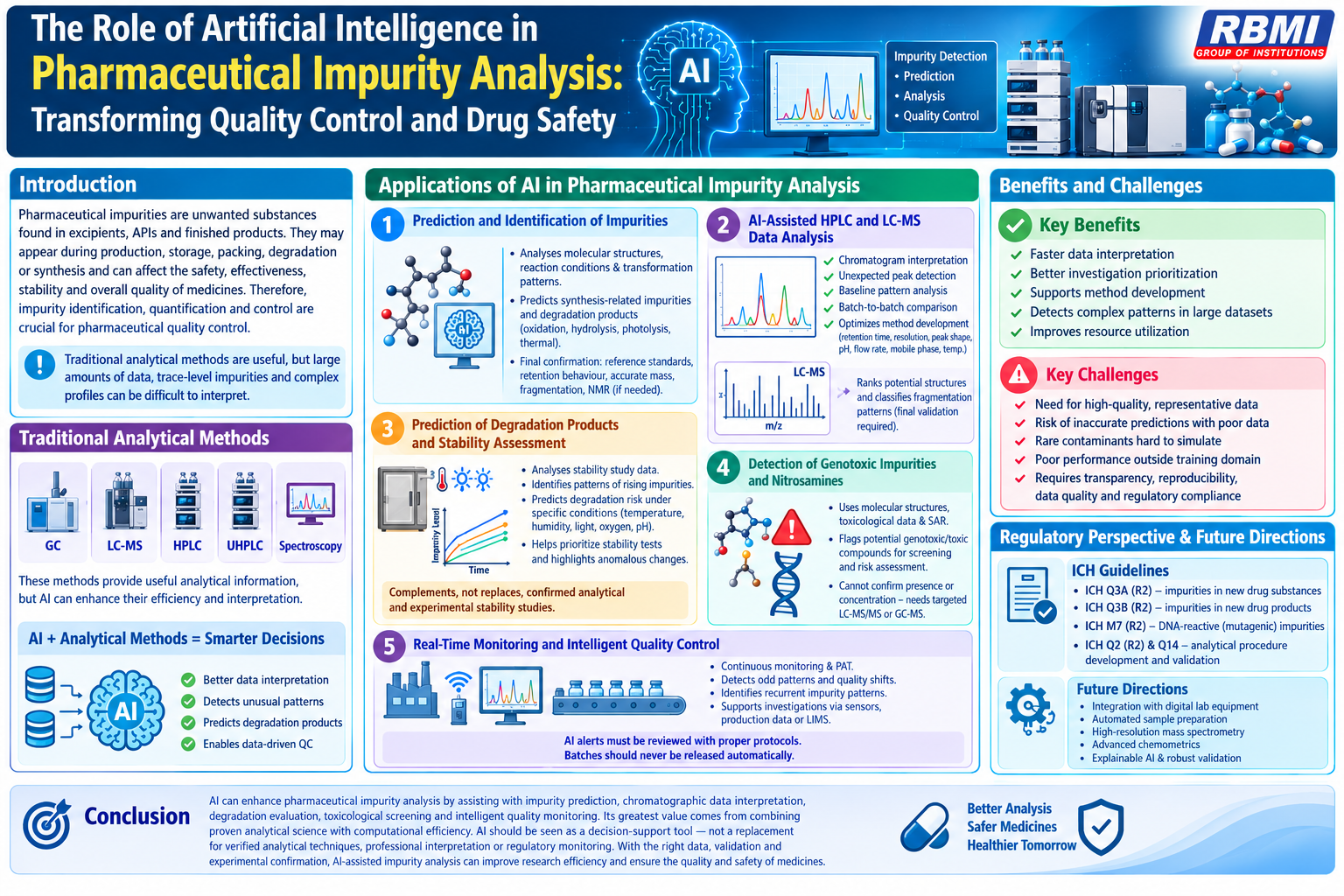
The Role of Artificial Intelligence in Pharmaceutical Impurity Analysis: Transforming Quality Control
Introduction: Unwanted substances known as pharmaceutical impurities can be found in excipients, active pharmaceutical ingredients (APIs), and completed pharmaceutical products. These contaminants may appear during the production, storage, packing, degradation, or synthesis of drugs. The safety, effectiveness, stability, and general quality of medications may all be impacted by their presence. Impurity identification, quantification, and control are therefore crucial elements of pharmaceutical quality control.Analytical methods include gas chromatography (GC), liquid chromatography–mass spectrometry (LC-MS), high-performance liquid chromatography (HPLC), ultra-high-performance liquid chromatography (UHPLC), and spectroscopy have historically been used in pharmaceutical impurity analysis. Large amounts of analytical data, trace-level pollutants, and complex impurity profiles can make interpretation difficult even if these approaches offer useful analytical information.
Applications of AI in Pharmaceutical Impurity Analysis:
1. Prediction and Identification of Impurities:One important application of AI is the prediction and identification of potential impurities. Machine-learning models can analyse molecular structures, reaction conditions, and chemical transformation patterns to help predict possible synthesis-related impurities and degradation products.For example, AI-assisted analysis can help researchers investigate potential impurities generated through oxidation, hydrolysis, photolysis, or thermal degradation. Computational predictions can narrow the list of compounds requiring experimental investigation.However, predicted impurities must be confirmed using appropriate analytical evidence, such as reference standards, retention behaviour, accurate mass measurements, fragmentation patterns, and, when necessary, nuclear magnetic resonance (NMR) spectroscopy.
2. AI-Assisted HPLC and LC-MS Data Analysis: For the separation, identification, and measurement of pharmaceutical contaminants, HPLC and LC-MS are frequently employed. Chromatogram interpretation, unexpected peak detection, anomalous baseline pattern identification, and comparison of impurity profiles between batches can all be aided by AI. By examining the connections between performance metrics like resolution, retention time, and peak shape and experimental factors like mobile-phase composition, pH, flow rate, and column temperature, machine-learning algorithms can also aid in the development of chromatographic methods.AI-based models can be used in conjunction with LC-MS data to rank potential structures for unknown contaminants and categorise fragmentation patterns. Although final identification needs scientific validation, these capabilities can cut down on the time spent on early data interpretation.
3. Prediction of Degradation Products and Stability Assessment: When developing and storing pharmaceuticals, one of the main concerns is drug deterioration. Temperature, humidity, light, oxygen, and pH can all affect how breakdown products arise. AI algorithms can examine data from stability studies and assist in spotting patterns linked to rising impurity levels. When appropriate training data are available, they may also aid in the prediction of deterioration risks under specified conditions. An AI-assisted workflow might, for instance, compare impurity profiles from samples kept in various humidity and temperature settings. The approach could help researchers prioritise stability tests and identify anomalous changes for additional study.These forecasts support confirmed analytical techniques and empirically established stability investigations rather than taking their place.