

Role of RBMI in Developing a Career as a Data Analyst
In the modern healthcare and pharmaceutical industry, data has become an essential part of
decision-making, patient care, medicine safety, and research. Hospitals, pharmaceutical
companies, and clinical research organizations rely on data to improve treatment outcomes,
monitor drug safety, and manage healthcare services efficiently. Because of this, data
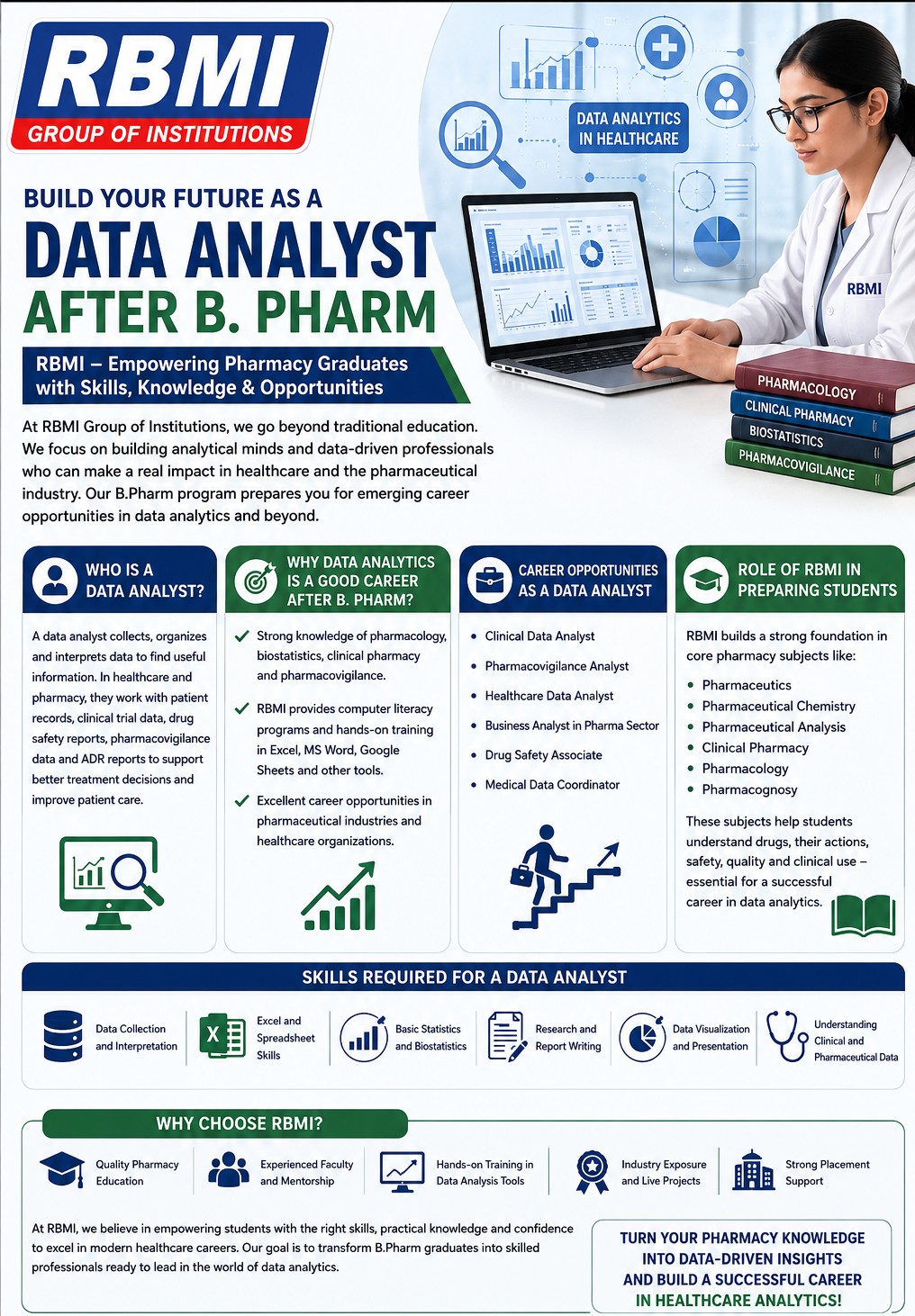
analytics has emerged as a promising career option for students after B. Pharm. A data analyst
in healthcare works with patient records, clinical trial data, prescription patterns, drug safety
reports, and pharmacovigilance data to identify trends, support treatment decisions, and
improve healthcare outcomes.
RBMI Group of Institutes plays an important role in preparing students for this growing field
by combining pharmaceutical education with practical and career-oriented learning. The
institute focuses on quality teaching, digital classes, and skill development to help students
build confidence and professional competence. Through its academic environment, RBMI
helps pharmacy students understand both healthcare systems and the use of data in
improving patient care and medicine safety.
For B. Pharm students, data analytics is a suitable career because their course already provides
knowledge in subjects such as Pharmacology, Clinical Pharmacy, Biostatistics,
Pharmaceutical Analysis, and Pharmacovigilance. These subjects give students a strong
understanding of medicines, adverse drug reactions (ADR), patient care, and clinical research.
When this pharmaceutical knowledge is combined with data-handling and analytical skills,
students can explore excellent opportunities in the healthcare and pharmaceutical industries.
RBMI supports this process by encouraging computer literacy and digital learning, helping
students gain familiarity with tools such as MS Excel, MS Word, Google Sheets, and other
data-management platforms that are useful in analytical work.
After B. Pharm, students can build careers in several data-related roles, including Clinical Data
Analyst, Pharmacovigilance Analyst, Healthcare Data Analyst, Drug Safety Associate, and
Business Analyst in the pharma sector. These roles involve analyzing healthcare information,
monitoring medicine safety, preparing reports, and supporting organizations in making
informed decisions. As the pharmaceutical and healthcare sectors continue to become more
digital and data-driven, the demand for professionals with both pharmacy knowledge and
analytical skills is increasing rapidly.
RBMI helps students prepare for these opportunities by building a strong foundation in core
pharmacy subjects such as Pharmaceutics, Pharmaceutical Chemistry, Pharmacology,
Pharmacognosy, Clinical Pharmacy, and Pharmaceutical Analysis. These subjects help
students understand drug formulation, mechanism of action, medicine safety, quality
assurance, and clinical applications of drugs. Along with academic knowledge, RBMI also
promotes practical learning and career-focused education, which are essential for developing
analytical thinking and professional skills.
To become a successful data analyst after B. Pharm, students should develop skills in data
collection and interpretation, Excel and spreadsheet handling, basic statistics and
biostatistics, report writing, data visualization, and understanding of clinical and
pharmaceutical data. These skills allow them to work effectively with healthcare information
and convert data into useful insights.