AI-Powered Research in Chemistry: Tools, Techniques and Best Practices
Imagine predicting a chemical reaction without performing dozens of experiments, identifying a promising drug molecule within minutes, or designing a new material using intelligent computer algorithms. This is no longer science fiction. Artificial Intelligence (AI) is transforming chemistry by making scientific research faster, smarter and increasingly data-driven.
Traditionally, chemical research involved extensive laboratory experimentation, repeated observations, complex calculations and time-consuming data analysis. Today, AI-powered technologies are helping chemists move beyond conventional approaches and explore new scientific possibilities.
How Is AI Transforming Chemical Research?
AI is creating exciting opportunities across different branches of chemistry:
- Molecular Design: AI algorithms predict molecular structures, chemical properties and potential applications of new compounds.
- Reaction Prediction: Machine learning models help predict chemical reactions, identify suitable reactants and suggest possible reaction pathways.
- Drug Discovery: AI supports pharmaceutical research by screening chemical compounds and identifying promising drug candidates.
- Material Science: Intelligent systems assist in discovering advanced polymers, nanomaterials, catalysts and sustainable materials.
- Spectroscopic Analysis: AI helps interpret complex IR, NMR, UV-Visible and mass spectroscopy data.
- Green Chemistry: AI supports the development of environmentally friendly chemical processes by identifying efficient reaction conditions and reducing waste.
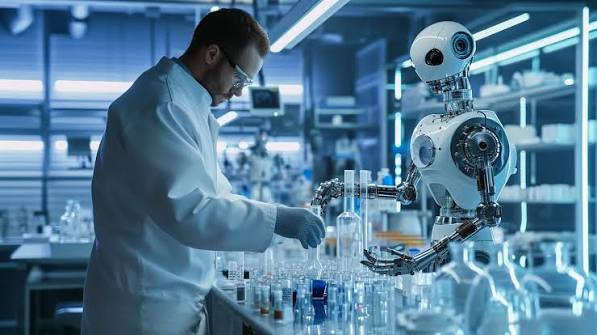
- Laboratory Automation: AI-enabled instruments and robotic systems improve sample preparation, experimental monitoring and repetitive laboratory operations.
Important AI Tools for Chemistry Researchers
Modern researchers can explore several AI-powered platforms and computational tools:
- ChatGPT: Helps explain chemical concepts, generate research ideas, organise literature reviews and assist with scientific writing.
- AlphaFold: Predicts protein structures, supporting research in structural biology and biochemistry.
- ChemDraw: Supports chemical structure drawing and reaction representation.
- RDKit: An open-source toolkit for cheminformatics and molecular data analysis.
- PubChem: Provides access to chemical structures, properties and biological information.
- Gaussian: Supports computational chemistry and molecular modelling.
- DeepChem: Provides machine learning tools for molecular modelling and chemical research.
Best Practices: How Should Researchers Use AI?
To obtain meaningful and reliable results, researchers should follow these essential practices:
- Verify Every Result: Never accept AI-generated chemical information without scientific validation.
- Use Reliable Data: Work with authentic datasets and credible research publications.
- Combine AI with Experiments: Validate predictions through laboratory investigations.
- Maintain Research Ethics: Avoid plagiarism, fabricated results and inappropriate use of AI-generated content.
- Protect Research Data: Maintain confidentiality and follow responsible data-sharing practices.
- Develop Critical Thinking: Treat AI as a research assistant, not a replacement for scientific judgement.
The Road Ahead
The future of chemistry will increasingly depend on collaboration between human intelligence, computational science and artificial intelligence. Students and researchers must develop AI literacy alongside strong fundamentals in organic, inorganic, physical and analytical chemistry.
Remember: AI can predict a chemical possibility, but scientific curiosity, experimentation and human intelligence transform that possibility into a meaningful discovery.
Think Chemically. Explore Digitally. Innovate Intelligently.